-01.png)

Garde Manger, Charcuterie, Breakfast & Egg Coookery
Module Outline:
-
About GMC-BEC + Food Safety & Sanitation for the Cold Kitchen [ ]
-
Kitchen Introduction & Mayonnaise Lab [ ]
-
Eggs & Breakfast Cookery 1 [ ]
-
Eggs & Breakfast Cookery 2 [ ]
-
Cold Sauces & Salads 1 [ ]
-
Cold Sauces & Salads 2 [ ]
-
Charcuterie, Sandwiches, Canapés & Hors d'oeuvres 1 [ ]
-
Charcuterie, Sandwiches, Canapés & Hors d'oeuvres 2 [ ]


Session 1:
About Garde Manger, Charcuterie, Breakfast & Egg Cookey
WELCOME TO THE COLD KITCHEN
The COLD KITCHEN is the production area responsible for cold food preparation, preservation and presentation. It requires strict temperature control, precision and sanitation discipline.
GARDE MANGER
Pronunciation: gard mahn ZHAY
French term meaning “keeper of the food.” In modern kitchens it refers to the cold station responsible for salads, cold sauces, sandwiches, charcuterie and buffet production.
CHARCUTERIE
Pronunciation: shar KOO tuh ree
The art and science of preserving and preparing meat through salting, curing, smoking and controlled processing. It is preservation through controlled microbial and moisture management.
BREAKFAST AND EGG COOKERY
The discipline of cooking eggs and breakfast items with precision temperature control and timing. Egg proteins coagulate within narrow temperature ranges, making accuracy critical for texture, safety and consistency.
FOOD SAFETY AND SANITATION
Food safety is the scientific control of time, temperature and contamination to prevent foodborne illness. Sanitation is the systematic cleaning and disinfecting of tools, surfaces and hands to maintain safe production standards.


Garde Manger
DEFINITION AND ORIGIN
Garde Manger, pronounced gard mahn ZHAY, is a French term meaning keeper of the food.
Historically it referred to a cool storage room used to preserve food before refrigeration.
In modern kitchens it is the cold production station responsible for preparing and assembling cold dishes.
It is an active production station, not a storage room.
CORE RESPONSIBILITIES
The Garde Manger station produces salads, cold sauces, dressings, sandwiches, canapés, charcuterie, cold protein preparations and buffet displays.
In hotels and catering operations this station may produce nearly half of total daily output.
Cold work requires precision because heat cannot correct mistakes.
Cold exposes flaws in texture, seasoning and knife work.
SCIENTIFIC FOUNDATION
Garde Manger operates on control of temperature, time and moisture.
Cold holding must remain between one and four degrees Celsius.
The danger zone for bacterial growth begins at five degrees Celsius and extends to sixty degrees Celsius.
Prepared cold food should not remain outside refrigeration beyond two cumulative hours.
High water activity promotes bacterial growth.
Salt, acid and refrigeration reduce microbial activity.
The cold kitchen is practical microbiology.
STRUCTURE OF A PROFESSIONAL STATION
A proper station includes refrigeration units, a cold prep table, separate raw and ready to eat zones and clearly assigned cutting boards and tools.
Raw proteins must never cross contaminate ready to eat food.
Hand washing facilities must be accessible at all times.
Sanitation discipline defines professionalism in the cold kitchen.
KNIFE SKILLS AND PRECISION
Uniform cuts ensure even seasoning, clean presentation and controlled portioning.
Common classical cuts include julienne, brunoise, chiffonade, batonnet and paysanne.
Professional vegetable waste should remain below eight percent.
Poor knife work increases food cost and reduces perceived quality.
GARDE MANGER IN THE 2026 PHILIPPINE / WESTERN MARKET
Cold kitchen production supports hotel breakfast buffets, corporate catering, event grazing tables, private dining, cloud kitchens and healthy bowl concepts.
High demand items include Caesar salads, grilled protein bowls, Japanese influenced salads and premium cold appetizers.
Cold dishes often maintain food cost between thirty and forty five percent when properly controlled.
Portion discipline protects profit margins.
VISUAL COMPOSITION
Cold food must sell visually.
Use color contrast, height variation and texture balance.
Plate edges must remain clean.
In the social media era, presentation influences bookings and pricing power.
RISK AREAS
Mayonnaise based sauces, raw egg products, cold buffets, sliced meats and improper labeling are high risk areas.
Most catering related foodborne illness originates from cold food mishandling.
One outbreak can destroy brand credibility.
Food safety is commercial survival.
WORKFLOW DISCIPLINE
Professional sequence begins with receiving and inspection, followed by proper storage, controlled prep, labeling, chilling, assembly and service.
Everything must be dated.
Everything must be labeled.
Nothing is assumed safe.
PROFESSIONAL MINDSET
Garde Manger is not a secondary station.
It demands organization, sanitation awareness, knife mastery and cost discipline.
A weak cold station weakens the entire kitchen.
A disciplined cold station stabilizes operations and increases profitability.
CLOSING
Mastering Garde Manger means mastering control.
If you can control temperature, time, portion and sanitation in the cold kitchen, you can operate a professional food business.


Charcuterie
DEFINITION
Charcuterie, pronounced shar KOO tuh ree, is the controlled preparation and preservation of meat.
It is preservation through salt, curing, smoking or drying under regulated conditions.
WHY IT MATTERS
Before refrigeration, preservation prevented spoilage.
Today it develops flavor, extends usability and increases product value.
It is controlled biochemical change, not simple cooking.
CORE METHODS
Salting
Salt reduces water activity and inhibits microbial growth.
Curing
Curing combines salt and controlled nitrite to prevent dangerous pathogens.
Smoking
Smoke deposits antimicrobial compounds and adds surface protection.
Drying
Moisture reduction limits bacterial survival when humidity and temperature are controlled.
THE SCIENCE
Bacteria require moisture, warmth and nutrients.
Charcuterie controls moisture and temperature to slow or prevent microbial growth.
Fresh sausage salt level typically ranges between one point five to two percent of meat weight.
Precision is mandatory. Estimation is unacceptable.
FRESH VERSUS DRY CURED
Fresh products
Sausage
Terrine
Rillette
These require refrigeration and proper cooking.
Dry cured products
Salami
Prosciutto
These require controlled humidity and temperature chambers.
In tropical Philippine climates, uncontrolled drying is unsafe.
FOOD SAFETY RISKS
Incorrect curing salt measurement
Temperature abuse
Cross contamination
Improper labeling
Preserved meats may not show visible spoilage.
Measurement and documentation are critical.
COMMERCIAL CONTEXT 2026
Applications include
Hotel buffets
Grazing tables
Premium sandwiches
Wine bars
Corporate catering
Charcuterie increases perceived value and menu pricing power.
Proper trim utilization improves margin control.
PROFESSIONAL STANDARD
Charcuterie demands discipline, sanitation and exact measurement.
It is applied food microbiology.
Master control before attempting creativity.
Breakfast & Egg Cookery
DEFINITION
Breakfast and Egg Cookery focuses on the controlled preparation of eggs and morning service items with precision in temperature, timing and consistency.
Eggs are protein systems that coagulate within narrow heat ranges, making control critical for texture and safety.
WHY IT BELONGS TO GARDE MANGER IN RESTAURANTS, HOTELS AND SHIPS
In many hotels and cruise ships, the breakfast station is managed under Garde Manger because it requires high volume production, strict timing and strong sanitation control.
The station often handles both hot egg production and cold breakfast components such as fruits, yogurts, smoked meats and cold platters.
OPERATIONAL LOGIC
Breakfast service is time sensitive and high volume.
Egg cookery demands temperature precision. Overcooking results in rubber texture. Undercooking creates safety risk.
Egg white coagulates at approximately sixty two to sixty five degrees Celsius.
Egg yolk coagulates at approximately sixty five to seventy degrees Celsius.
Holding scrambled eggs or omelets improperly can quickly destroy texture and quality.
SAFETY CONSIDERATIONS
Eggs are a high risk ingredient due to potential Salmonella contamination.
Proper refrigeration below four degrees Celsius is mandatory.
Cross contamination between raw shell eggs and ready to eat food must be prevented.
COMMERCIAL IMPORTANCE
Hotel breakfast defines guest perception of quality.
Consistency, speed and control determine profitability.
A disciplined breakfast station supports brand reputation and operational stability.

Food Safety & Sanitation
(Especially in Cold Kitchen)
WHY THIS MATTERS
Food safety is the control of time, temperature and contamination to prevent foodborne illness.
Sanitation is the systematic cleaning and disinfecting of hands, tools and surfaces to maintain safe production.
In the cold kitchen there is no final heat step to destroy bacteria.
Control must happen before service.
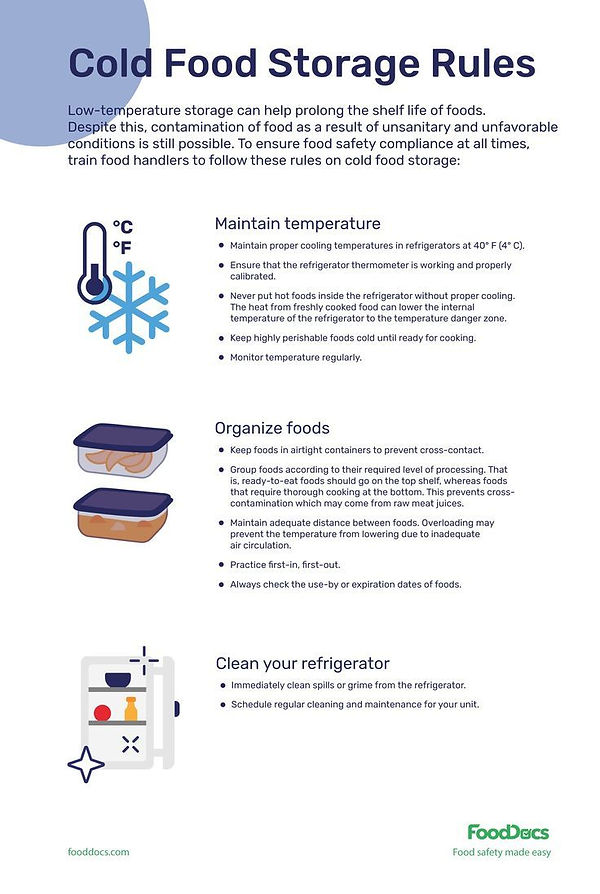
TEMPERATURE CONTROL
Danger zone
5°C to 60°C (metric system)
41°F to 140°F (American system)
Cold holding
1°C to 4°C (metric system)
34°F to 40°F (American system)
Maximum cumulative time outside refrigeration
2 hours
Bacterial growth accelerates above 5°C or 41°F.
Cold food must remain below this threshold at all times.
EGG SAFETY REFERENCE
Egg white coagulation
62°C to 65°C (metric system)
144°F to 149°F (American system)
Egg yolk coagulation
65°C to 70°C (metric system)
149°F to 158°F (American system)
Minimum safe reheating temperature
74°C (metric system)
165°F (American system)
HIGH RISK FOODS IN THE COLD KITCHEN
Leafy vegetables
Cooked rice used in salads
Mayonnaise based sauces
Cold cuts
Egg products
Seafood
These foods support rapid microbial growth if temperature is abused.
PERSONAL HYGIENE
Hand wash minimum 20 seconds with soap and running water.
Wash hands after handling raw meat.
After cracking eggs.
After touching face or phone.
No jewelry.
Hair restraint required.
Clean uniform required.
The food handler is the primary contamination risk.
CROSS CONTAMINATION
Raw meat must never contact ready to eat food.
Use separate cutting boards and knives.
Sanitize surfaces between tasks.
Store raw products below ready to eat items in refrigeration.
CLEANING AND SANITIZING
Cleaning removes visible soil and grease.
Sanitizing reduces microorganisms to safe levels.
Correct sequence
Clean
Rinse
Sanitize
Air dry
Follow manufacturer instructions for sanitizer concentration in ppm.
BUFFET AND SERVICE CONTROL
Cold food must remain below
5°C (metric system)
41°F (American system)
Use ice baths or chilled trays.
Monitor time exposed at room temperature carefully.
PROFESSIONAL STANDARD
Food safety protects the guest, the business and your career.
1 incident can destroy a brand.
In the cold kitchen discipline equals survival.




Practice Quiz Reviewer
Questions May Come it In Finals ;)
FOOD SAFETY AND COLD KITCHEN
REVIEWER QUIZ
TOTAL 20 POINTS
Answer clearly. 1 point each.
1 - State the danger zone temperature range in metric system.
2 - State the danger zone temperature range in American system.
3 - State the correct cold holding temperature range in metric system.
4 - State the correct cold holding temperature range in American system.
5 - State the maximum cumulative time food may stay outside refrigeration.
6 - State the egg white coagulation temperature range in metric system.
7 - State the egg white coagulation temperature range in American system.
8 - State the minimum safe reheating temperature in metric system.
9 - State the minimum safe reheating temperature in American system.
10 - Define cross contamination in 1 sentence.
11 - Explain why the cold kitchen is considered high risk compared to the hot kitchen.
12 - Name 3 high risk foods commonly handled in the cold kitchen.
13 - Explain why raw meat must be stored below ready to eat food in refrigeration.
14 - Write the correct sequence for cleaning and sanitizing surfaces.
15 - Explain why mayonnaise based products are high risk.
16 - State the required hand washing time in seconds.
17 - Explain why labeling and dating food is critical.
18 - Explain in 1 sentence why temperature control is critical in charcuterie.
19 - State 1 reason hotel breakfast egg production requires strict temperature control.
20 - In 1 sentence explain why food safety is a commercial survival skill.

Session 2:
Kitchen Orientation & Mayonnaise Lab
WELCOME TO THE KITCHEN
Basic checklist for kitchen orientation
-
THE RIGHT REASONS
-
SAFETY FIRST
-
CLEAN HANDS
-
CLEAN STATIONS
-
CLEAR MIND & WORKFLOW (PREP LIST)
-
STATION SET UP
-
BEST PRACTICES
-
TIME KEEPING
-
KEY SUCCESS AREAS
-
DISHWASHING PROCEDURES
-
STATION CLEAN UP & DOING YOUR PART
-----------------------------
MAYONNAISE
BASIC EMULSION
INGREDIENTS
2 egg yolks
3/4 cup neutral oil 180 ml
1 tbsp vinegar 15 ml
Salt to taste
White pepper to taste
PROCEDURE
-
Place yolks and vinegar in bowl. Whisk until combined.
-
Slowly drizzle oil while whisking continuously until thick and emulsified.
-
Season with salt and white pepper.
-
Chill immediately. Store at 1°C to 4°C 34°F to 40°F.
-----------------------------
FRESH POTATO CHIPS
SKIN ON
INGREDIENTS
Potatoes, washed, skin on
Salt
Neutral oil for frying
PROCEDURE
-
Slice potatoes thin using mandolin. Keep slices uniform.
-
Rinse in cold water to remove excess starch. Drain well.
-
Pat completely dry. Moisture causes oil splatter.
-
Fry in oil at 170°C to 180°C 340°F to 356°F until golden and crisp.
-
Drain on rack or paper.
-
Season immediately with salt.


30 Amazing Mayo Based Recipes both Classic & Modern
CLASSIC AND MODERN MAYONNAISE BASED SAUCES
RECIPE FORMULAS WITH PAIRINGS
1 - REMOULADE (France)
Mayo + Dijon mustard + capers + cornichons + parsley + lemon juice
Best served with fried seafood, crab cakes, cold meats
2 - TARTAR SAUCE (France)
Mayo + cornichons + capers + parsley + lemon juice
Best served with fried fish, fish and chips, breaded shrimp
3 - THOUSAND ISLAND (USA)
Mayo + ketchup + pickle relish + onion + vinegar
Best served with burgers, Reuben sandwiches, salads
4 - AIOLI (France Spain)
Mayo + garlic + lemon juice + olive oil
Best served with grilled vegetables, seafood, roasted potatoes
5 - GARLIC AIOLI (Modern)
Mayo + roasted garlic + lemon + white pepper
Best served with fries, sandwiches, grilled chicken
6 - CHIPOTLE MAYO (Mexico inspired)
Mayo + chipotle in adobo + lime juice + salt
Best served with tacos, burgers, grilled meats
7 - SRIRACHA MAYO (Asia modern)
Mayo + sriracha + rice vinegar + sugar
Best served with sushi rolls, fried chicken, sandwiches
8 - WASABI MAYO (Japan modern)
Mayo + wasabi paste + lemon
Best served with tempura, seafood, sushi
9 - HONEY MUSTARD (France USA)
Mayo + Dijon + honey + vinegar
Best served with fried chicken, salads, sandwiches
10 - CAESAR STYLE MAYO (Italy USA)
Mayo + anchovy + garlic + lemon + Parmesan + black pepper
Best served with romaine lettuce, grilled chicken, croutons
11 - COLESLAW DRESSING (USA)
Mayo + apple cider vinegar + sugar + salt
Best served with shredded cabbage, pulled pork, BBQ
12 - GREEN GODDESS (USA)
Mayo + herbs + anchovy + lemon + garlic
Best served with salads, grilled fish, vegetable platters
13 - RUSSIAN DRESSING (USA)
Mayo + ketchup + horseradish + paprika
Best served with deli sandwiches, roast beef, burgers
14 - SAUCE GRIBICHE (France)
Mayo + chopped boiled egg + capers + herbs + mustard
Best served with cold meats, boiled beef, asparagus
15 - SAUCE ANDALOUSE (Belgium)
Mayo + tomato paste + roasted red pepper + lemon
Best served with fries, grilled sausages, sandwiches
16 - LOUISIANA REMOULADE (USA)
Mayo + Creole mustard + paprika + hot sauce + pickle
Best served with shrimp, fried seafood, po boys
17 - PERI PERI MAYO (Portugal Africa modern)
Mayo + peri peri chili + lemon + garlic
Best served with grilled chicken, fries, sandwiches
18 - CURRY MAYO (UK India modern)
Mayo + curry powder + lemon + salt
Best served with chicken salad, sandwiches, roasted vegetables
19 - TRUFFLE MAYO (France modern)
Mayo + truffle oil + black pepper
Best served with fries, steak sandwiches, gourmet burgers
20 - BASIL MAYO (Modern)
Mayo + basil puree + lemon
Best served with grilled fish, chicken, vegetable sandwiches
21 - PESTO MAYO (Italy modern)
Mayo + pesto + lemon
Best served with panini, roasted vegetables, chicken wraps
22 - SMOKED PAPRIKA MAYO (Spain modern)
Mayo + smoked paprika + garlic + lemon
Best served with grilled meats, potatoes, seafood
23 - BBQ MAYO (USA modern)
Mayo + BBQ sauce + apple cider vinegar
Best served with burgers, pulled pork, fries
24 - TERIYAKI MAYO (Japan modern)
Mayo + teriyaki reduction + rice vinegar
Best served with grilled chicken, rice bowls, sushi rolls
25 - MISO MAYO (Japan modern)
Mayo + white miso + rice vinegar + sugar
Best served with roasted vegetables, grilled fish, sandwiches
26 - KIMCHI MAYO (Korea modern)
Mayo + minced kimchi + sesame oil
Best served with fried chicken, burgers, rice bowls
27 - LEMON DILL MAYO (Scandinavia)
Mayo + dill + lemon zest + lemon juice
Best served with smoked salmon, seafood, cold platters
28 - AVOCADO MAYO (Modern)
Mayo + avocado puree + lime juice + salt
Best served with tacos, wraps, grilled chicken
29 - HARISSA MAYO (North Africa)
Mayo + harissa paste + lemon + garlic
Best served with grilled lamb, roasted vegetables, sandwiches
30 - GINGER SESAME MAYO (Asia modern)
Mayo + grated ginger + sesame oil + rice vinegar
Best served with slaws, grilled chicken, rice bowls